Hello everybody, hope you are having an incredible day today. Today, we’re going to make a special dish, miang kham. One of my favorites. This time, I am going to make it a little bit tasty. This will be really delicious.
Miang Kham is one of the most popular of recent trending foods on earth. It’s appreciated by millions every day. It’s easy, it is fast, it tastes yummy. Miang Kham is something which I’ve loved my entire life. They’re nice and they look wonderful.
Serving miang kham Fold betel leaf mian kham I waited all year to come home and make miang kham, which is potentially the most unique tasting dish I've made so far on the show! There really isn't anything quite like it. Miang kham originated in the northern part of Thailand using pickled tea leaves and was introduced to the Siamese court of King Rama V by Princess Dara Rasmi.
To begin with this recipe, we have to prepare a few ingredients. You can have miang kham using 16 ingredients and 7 steps. Here is how you can achieve it.
The ingredients needed to make Miang Kham:
- Prepare Condiment part
- Prepare 10-15 wild betel leaves
- Prepare 1 cup dry shrimp
- Prepare 2-3 shallots (peeled, chopped into small dices)
- Get 1 cup cashew nuts
- Get 2 tbsp bird eyes red chilli (finely sliced)
- Take 1/2 cup fresh ginger (peeled and cut into small cube)
- Make ready 1-2 lime (segmented, cut into small pieces)
- Make ready 1 Desiccated coconut
- Prepare Miang sauce
- Take 200 g palm sugar
- Prepare 30 ml water
- Get 2-3 tbsp tamarind paste
- Get 1 tsp fishsauce
- Take 1 tsp dry chilli flakes (optional)
- Prepare 1 lemon grass (cut and bruise)
Orginally from the North of Thailand and is influenced by Burmese cuisine. Thai Appetizer - Miang Kham Recipe. Miang Kham - it's Thailand in one bite! Okay guys here it is, we've just found Thailand's most amazing appetiser!
Steps to make Miang Kham:
- Lightly toasted your dry shrimps and cashew nuts (one ingredient at time) on and medium heat non-oil pan for about 5-8 min. Put them in a small bowl each. Wash and dry wild betel leaves. I bought them from china town in London but you can but them online. If you cannot fine wild betel leaves you can use green cabbage.
- Toasted desiccated coconut on medium heat non-oil pan for 8-10 min or until the desiccated coconut become golden brown. Put them in a small bowl.
- To make the maing sauce, Melt the palm sugar with the water, tamarind paste, lemongrass and fishsauce in a small pan.
- Once all the sauce melted and combined, you’re looking for a treacle-like consistency. Do not cook for too long as it will make the mixture too sticky. Strain the lemon grass off and add some chilli flakes if prefer. The maing sauce should set and solidify a bit once it’s cold.
- Plate up your maing and sauce in a serving plate.
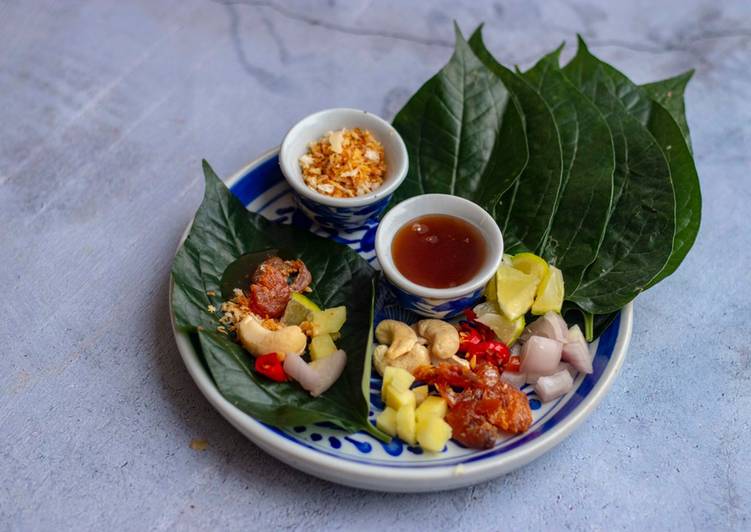
- Lay the betel leaves on a flat surface, spoon on some of the diced lime, shrimps, ginger, shallots, cashews and more sliced chilli, if you would like some extra heat and add maing sauce on top.
- Eat in one bite wrapped in the leaf. It should offer the burst of all beautiful Thai flavours in a mouthful – bitter from the leaf, salty from the shrimp, sour from the lime and spicy from the chilli. It’s very addictively delicious.
Known as Miang Kham, they're like a taste of Thailand in - you guessed it - one. Miang kham is a traditional Southeast Asian snack from Thailand and Laos. It was introduced to the Siamese court of For faster navigation, this Iframe is preloading the Wikiwand page for Miang kham. This page is also available in: Thai. Miang kham is a leaf-wrapped hors d'oeuvre that, in addition to its ingredients, binds together the history of two kingdoms, tea culture and the life of one queen.
So that’s going to wrap it up for this special food miang kham recipe. Thank you very much for reading. I’m sure you will make this at home. There is gonna be more interesting food at home recipes coming up. Remember to bookmark this page in your browser, and share it to your family, colleague and friends. Thank you for reading. Go on get cooking!