Hey everyone, it is me again, Dan, welcome to my recipe page. Today, I will show you a way to make a distinctive dish, vegan agedashi tofu with seaweed 🌱. It is one of my favorites food recipes. This time, I’m gonna make it a little bit unique. This will be really delicious.
Vegan Agedashi Tofu with Seaweed 🌱 is one of the most well liked of current trending foods on earth. It is enjoyed by millions daily. It is easy, it’s quick, it tastes yummy. Vegan Agedashi Tofu with Seaweed 🌱 is something that I’ve loved my whole life. They’re fine and they look fantastic.
Great recipe for Vegan Agedashi Tofu 🌱. Agedashi is probably the dish that best sums up why I am so passionate about vegan cooking. It's a dish that is almost (although rarely) vegan when you buy it from a restaurant as it uses dashi, a Japanese umami stock that is traditionally made with fish.
To get started with this particular recipe, we have to first prepare a few ingredients. You can have vegan agedashi tofu with seaweed 🌱 using 9 ingredients and 5 steps. Here is how you can achieve that.
The ingredients needed to make Vegan Agedashi Tofu with Seaweed 🌱:
- Make ready 1 block Soft or silken tofu
- Get 5 tablespoons Potato starch
- Get 1 splash oil for frying
- Take 5 tablespoons Soy or ponzu (lime, yuzu, lemon or lemon verbena)
- Prepare Vegan dashi (kombu seaweed and shittake)
- Prepare 1 sprinkle of Nori Seawwed
- Get 1 sprinkle of Aomori seaweed
- Prepare Spring onions (just the greens)
- Get Grated radish and/or ginger
It's lovely to serve on iced water which I flavour with some lemon verbena from the garden. Agedashi tofu, or 揚 げ 出 し 豆 腐 is firm tofu dredged in flour or starch and deep-fried to make a crispy outer shell, while leaving a fluffy, pillowy inside. It is a Japanese tofu dish typically served in a kombu and bonito flake dashi with grated ginger and green onion. Agedashi Tofu is a small piece of tofu dusted with Katakuriko potato starch and deep-fried.
Instructions to make Vegan Agedashi Tofu with Seaweed 🌱:
- Prepare the vegan dashi stock in advance. You will need to lightly simmer 1 shiitake and 1 inch piece of kombu per cup of water. A long and gentle simmer is best but if you are short of time you can make in half an hour. Cool until ready to use. Vegan dashi can be used in lots of recipes and adds umami 😋
- Gently drain the tofu and place on kitchen paper. You can’t press in the same way as you would a firmed tofu as it’s really delicate. Cut into cubes.
- Prepare the sauce by using a little dashi stock and simmering in a pan with soy sauce or ponzu and a few pinches of sugar. The sauce will thicken slightly but don’t overcook. I seasoned mine with some lemon verbena from the garden. It should be served warm and the cubes will sit in the sauce.
- Dip each side of the tofu square into the potato flour. Heat a little oil and gently fry on each side. It should colour but not brown.
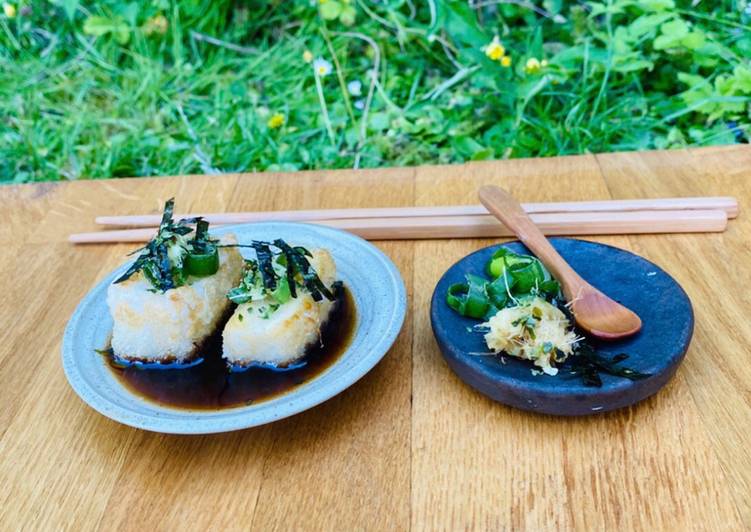
- Sprinkle with your choice of toppings (you only need a tiny bit). This time I used nori and aonori seaweed, spring onion, ginger and grated pinch radish. I also like grated white radish (mooli).
When the dusted katakuriko is deep-fried, it creates a crispy coating outside and the tofu stays soft inside. Nearly all Japanese restaurants serve Agedashi Tofu as it is a very popular menu item, along with Yakitori and Tsukune, not only in Japan but. Dashi is usually made with fish, but you can buy or make vegan versions. In this recipe, we've used one from Japan Centre, Shimaya Kelp Dashi Stock Powder. This recipe also makes use of some of your favourite Japanese ingredients and cupboard staples like tamari, mirin, seaweed flakes and tofu.
So that is going to wrap this up with this exceptional food vegan agedashi tofu with seaweed 🌱 recipe. Thank you very much for your time. I’m sure you can make this at home. There is gonna be more interesting food at home recipes coming up. Don’t forget to save this page on your browser, and share it to your loved ones, colleague and friends. Thanks again for reading. Go on get cooking!